Dessert

Tapioca and Buckwheat Gluten-and-Dairy Free Crepe Batter


Savory Breakfast Crepes

Yesterday I woke and immediately started daydreaming about Sunday breakfast.   With all the writing and social networking that goes with my job(s), sometimes I just get cranky for time IN the actual kitchen.

Crepes.  I don’t know why, but I started daydreaming about crepes.  Filled with eggs and goat cheese and something bright colored to remind me what spring looked like.  Luckily I was only a few blocks from Whole Foods, where a bunch of gorgeous little tomatoes from Mexico found their way into my basket, along with some fresh cilantro and small Mexican champagne mangoes.  The sun was out, the air was warm, I walked home with my jacket unbuttoned and my raggedy hair blowing in the wind.  New Yorkers had a bit more of a spring to their step, and I didn’t realize at the time how this quick break from the cold would make smiles turn up a bit more on most of the lovely people I’d encounter in my day.

Anyway, back in the kitchen.  I had decided on using a little buckwheat – which is common in some crepe recipes but used sparingly as it can be a bit bitter – and tapioca flour to pull along with the eggs and soymilk I was using for the crepe batter.  A tiny bit of butter and salt, and that’s it!  I utilized the whipping strength of a blender and the ease of a non-stick skillet to aid in making sure that the eggs would be beaten light and fluffy and the crepes easy to flip.  When the first one actually WORKED I called my boyfriend to the stove, giddy like a school-child out the first day of holiday.  We delighted in a few seconds of cheery contentment, flipping gluten-and-dairy-free crepes onto a waiting pan while eggs slow-cooked nearby.

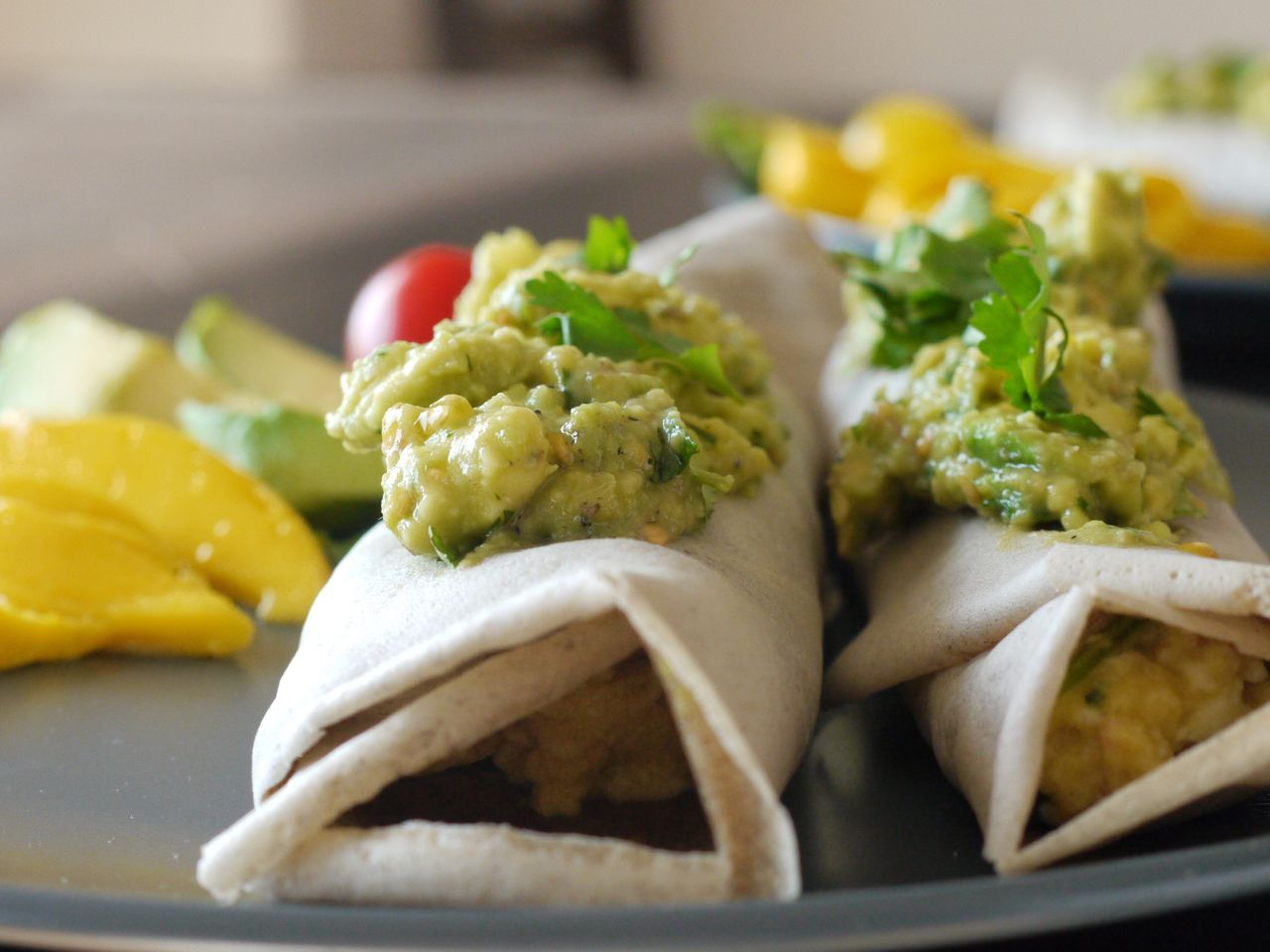
This recipe is quite simple, and quick, and with a little practice I soon had a stack of warm crepes that I filled with sauteed eggs and served with a guacamole-type mix and the freshly sliced champagne mangoes.

It was a good, good, good day.

Ingredients

  • 1 1/3 cup soy or unsweetened almond milk
  • 2 eggs
  • 1 cup tapioca flour
  • 1/3 cup buckwheat flour
  • pinch of salt
  • 2 tsp melted butter or olive oil

Directions

Whip eggs and milk of choice in blender until creamy and a bit fluffy (if you don’t have a blender you can use a standing or hand mixer, or just whip the heck out of them with a whisk).  Add the flours 1/3 a cup at a time, whipping thoroughly with each addition.  Add the melted butter or oil and salt and whip quickly to incorporate.

Heat a large non-stick skillet on medium high heat and spray lightly with cooking spray.  Hold skillet away from heat and let cool for 5 seconds, then pour enough batter in the center of the skillet, swirling quickly to cover the entire surface, until the bottom of the skillet is just covered with batter.  Return to heat and cook for 15-20 seconds or until the sides of the crepe start to curl.  Flip gently and cook on the other side another 20 seconds.  Remove to plate.  Repeat until you get a pretty stack of crepes!

Before I started cooking the crepes I had a second skillet going on low heat with melted butter, slowly stirred eggs, fresh cilantro, soft goat cheese and the skins of these tomatoes:
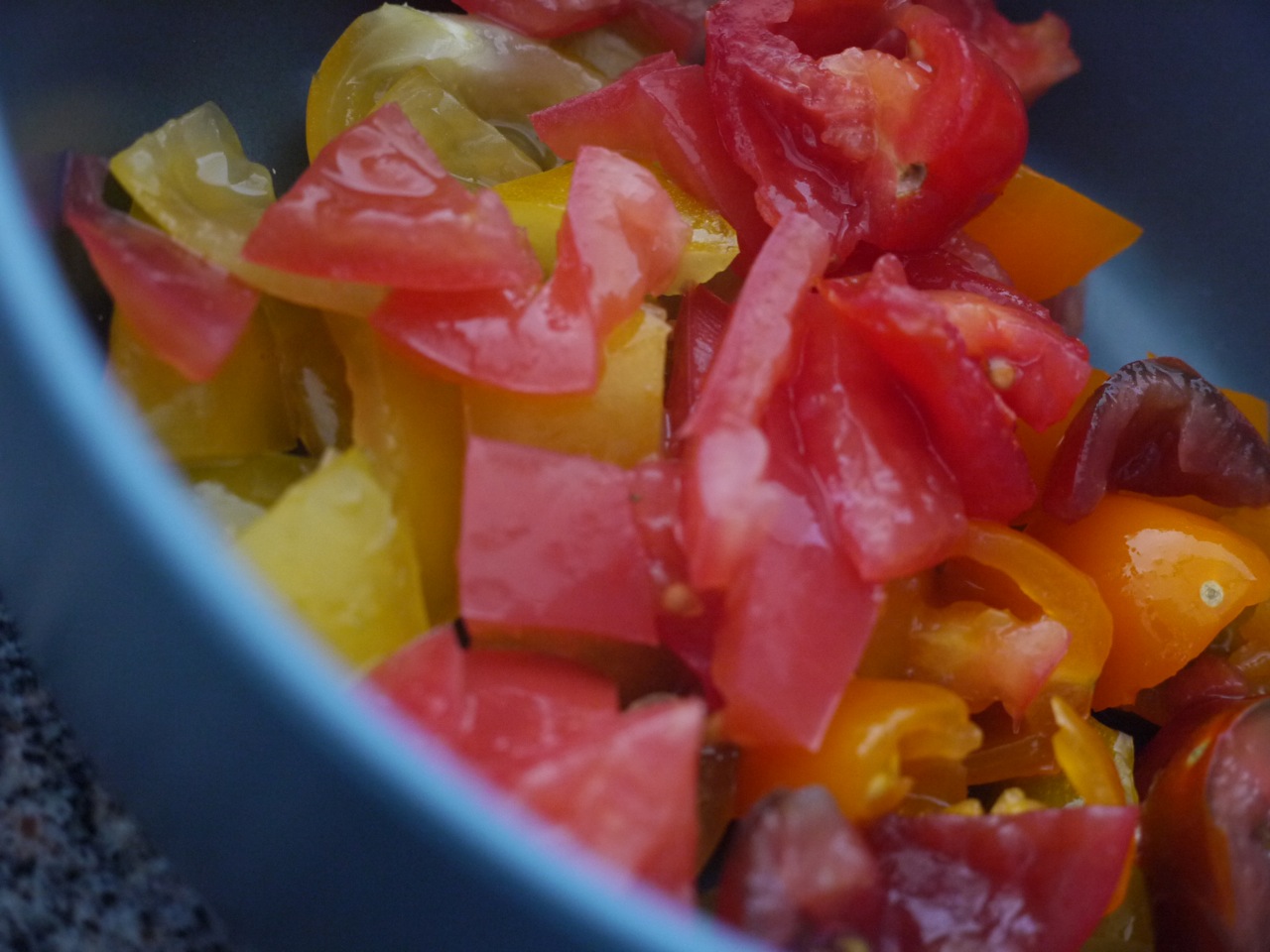
I then reserved the insides of them and mashed them with avocado, more cilantro, a squirt of fresh lemon juice (in the absence of lime) and some sea salt and pepper.  And then adorned the dish with the fresh champagne mangoes.  They’re a little tarter, firmer and less fibrous than regular mangoes.

While the tomatoes weren’t quite what I wanted (beautiful in color but still lacking that perfect summer tomato sweetness), it was a gorgeous dish, paired with orange juice and locally roasted coffee.  The perfect start to one of the best Sundays I’ve had in a long while.
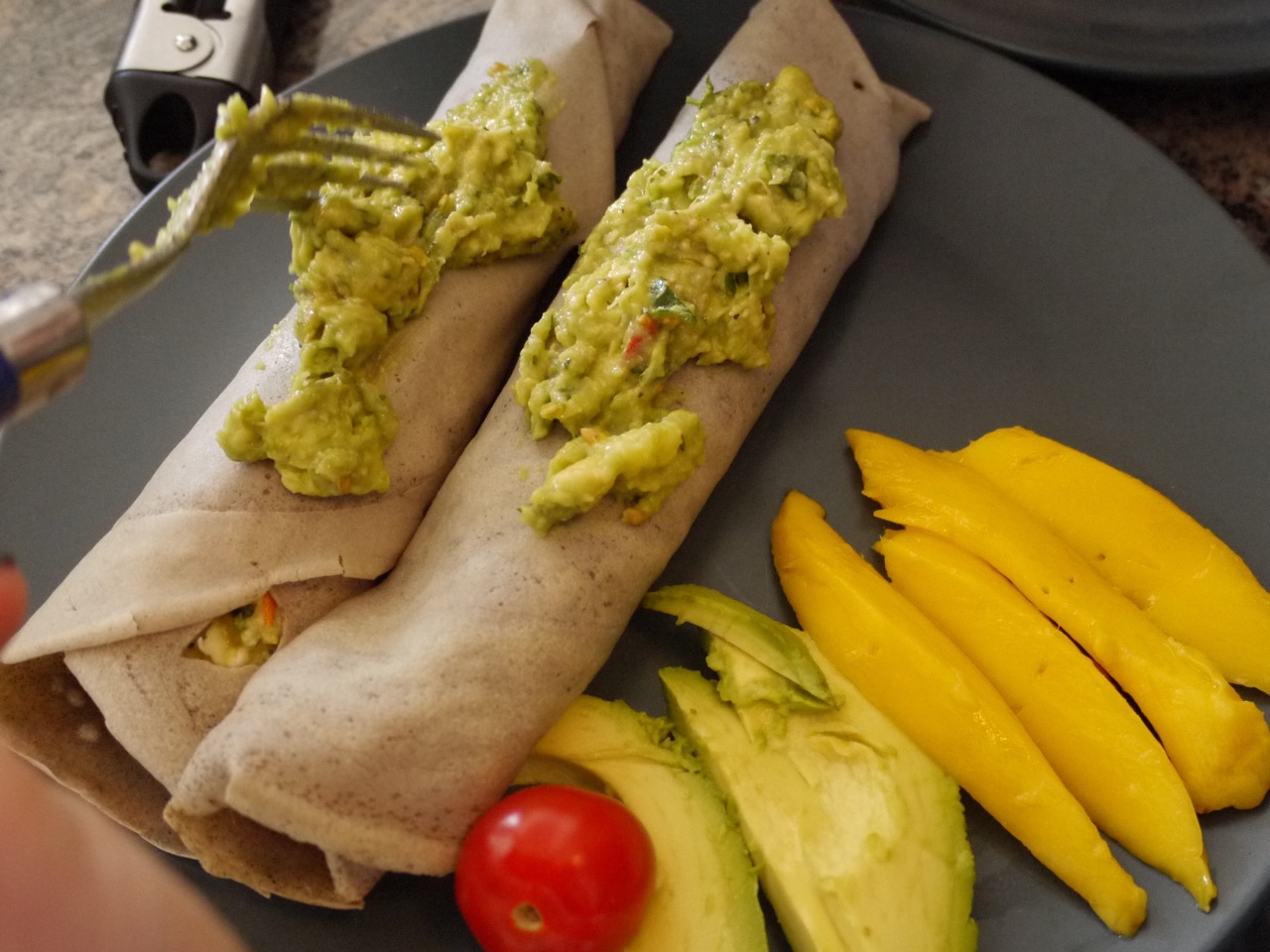
 

Creamy egg-filled crepes with champagne mangoes, avocado and Mexican tomatoes

Gluten and Dairy-Free Irish Soda Bread

Back-story to this recipe: In a few weeks I’ll be hosting my annual St. Patrick’s Day party.  It started several years ago, when my boyfriend-at-the-time-now-best-friend moved in with me in Queens.  He’s from an Irish family (Ruark Michael Downey – you don’t get more Irish than that!) and I’d been to Ireland several times at that point.  What naturally followed was a succession of parties where we’d bring in a keg of Guinness, bottles of whiskey and Irish cream, and I’d make a full boiled dinner.  The second year I made lamb stew and corned beef and cabbage.  Subsequent years brought us to the point where we were making 9 corned beefs and I was whipping up car-bomb cupcakes by the several dozen.  We needed nothing more than good food, good booze and the company of our lovely friends.

This year I’m doing a bit of experimenting with gluten-and-dairy-free recipes to include with the traditional ones I’ll be presenting.  For this  I found the most traditional Irish Soda Bread recipe I could find, having discarded anything fancy and landing on one with thorough directions and a bit of history.

So, the Irish are famous for soda bread for two reasons: the abundance of soft wheat with a lower gluten content and the availability of fuel for home fires and therefore the ability to bake bread at whim.  Simple ingredients (flour, milk, salt and baking soda) create a quick bread that’s delicious with a bowl of thick stew or layered around cold meat.  Since you don’t want the gluten to develop (as you would with a harder wheat and yeast combo), this makes this bread perfect for a gluten-free version.  I tried to approximate the taste of flour I remember from my glutenous soda-bread days, so threw in some oat and quinoa flour with the bulky rice flour and starches.  And I soured unsweetened almond milk, hoping that the vinegar would produce the proper chemical reaction with the baking soda.

The result?  This bread is delicious!  Deceptively sweet, especially as it contains NO SUGAR.  And popping warm, it’s perfect with a touch of Irish butter.  I gave some to my friend Lynn and her boyfriend Griff, who’s from Ireland.  His response: “this is a very close approximation of the bread of my people”.  They gobbled them up.

For this go around I made 8 mini loafs from the recipe to cut down the baking time dramatically.  For St. Pat’s I’ll be making two full loaves along with a wheat-flour version.  I have a feeling the recipe is equally successful either way.

Ingredients

  • 1 cup gluten-free whole-grain oat flour
  • 1 cup white rice flour
  • 1/2 cup quinoa flour
  • 1/2 cup tapioca flour / starch
  • 1/2 cup arrowroot starch
  • 1 1/2 tsp baking soda
  • 1 tsp salt
  • 1 Tbsp sugar (optional – I did not use)
  • 8-10 oz buttermilk or soured milk of choice at room temperature (directions below)
  • 1/2 cup dried currants (optional)

Directions

  • Preheat oven to 45o degrees.  It should be fully preheated and nice and hot before you put the bread in.
  • Lightly flour a heavy baking sheet with gluten-free flour.
  • In a large bowl, sift together the flours, salt, sugar and baking soda.  Gather and sift again, so that the baking soda is fully dispersed.  Make a well in the center.
  • If using regular milk or milk alternative: measure one Tbsp white or red wine vinegar in a 2-cup measuring cup.  Add enough milk to make 10 oz.  Use a fork to mix thoroughly.
  • Slowly pour about 8 oz of the milk into the well of flour, and quickly start blending with fork until it starts to pull together.  The mixture should be rather lumpy and on the drier side, but pulled together.  Add currants and fold in gently.  If too dry, add remaining milk until mixture pulls together.
  • Turn onto a slightly floured board and knead just until the dough is one, about 15 seconds / 6 kneads.  Don’t over knead.
  • Break dough into 8 balls, and press into slightly flat disks.  Using a sharp knife, cut a cross in each loaf about 1/3 into the dough.
  • Place in hot oven and bake 13 minutes, or until the tops are slightly brown.  If you tap on the bottom of  a loaf, it should sound hollow.  The dough in the center should be slightly soft though.
  • Cool before eating or enjoy warm with melted butter.

One-loaf Option: Shape into one loaf, slice the cross in, and bake for 10 minutes at 450 degrees, then decrease heat to 400 degrees and bake for 25 minutes longer or until crisp on top and sounding hollow with a tap on the bottom.

Note: This recipe is dedicated to my lovely roommate, Erika.  She’s been working so much lately that she hasn’t been able to (in her opinion) contribute to the upkeep of our generally clean apartment.  So she paid someone to come in and wash and scrub everything, and we lounged in our immaculate living room, catching up.  And less than an hour later, I was in the kitchen… and it got a bit dusty.

Coriander Cinnamon Carob Candy

Coriander Cinnamon Carob Candy

Rustic.

That’s a word I’ve been throwing around my kitchen lately.  My ambitions with allergy-alternative baking are to make gorgeous treats just as delectable for those without sensitivities as those with, that are as appealing to the eyes as they are to the tastebuds.

But sometimes things just look…rustic.  They taste delicious but look a bit like the ugly duckling pre-swan-age.

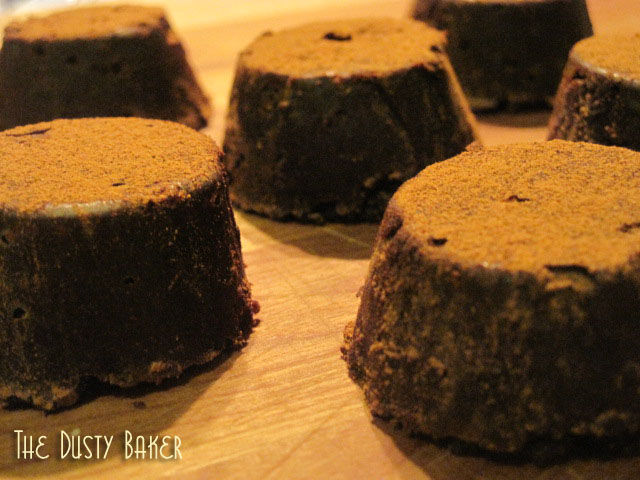
This recipe is one such recipe.  I’m playing with molding carob powder with spices and fat into a hard candy that is satisfying and palatable for even the most sensitive stomachs.  Once again, this combination tastes delicious – with citrusy tangs of coriander and a cinnamon spice – but it took a while to get them to release easily from the molds.  Like the little engine, I think I can, I think I can, I think I can… but for now I’ll enjoy my “rustic” treats.

Ingredients

  • 1/2 cup ghee (clarified butter) or unsalted butter
  • 1 1/2 tsp ground decaffinated coffee
  • 1 tsp coriander seeds, crushed
  • 2 Tbsp cinnamon, plus more for dusting
  • 3/4 cup coconut creme
  • 1 cup carob powder

Directions

  • Lightly grease mini-cupcake tins and dust heavily with cinnamon
  • Place a small pot on low heat and melt ghee or butter
  • Add 2 Tbsp cinnamon, coffee and coriander, and whisk to combine
  • Let sit on low heat for about 5 minutes to infuse
  • Slowly whisk in coconut creme, doing so until thoroughly combined and the mixture is a light brown with all the butter absorbed
  • Add carob, 1/4 cup at a time, whisking thoroughly with each addition.  By the second addition, the ghee may separate from the creme and start to lump with the carob: don’t sweat this.  It should absorb back into the final mixture, which should be rather lumpy.  The mixture should not be smooth like chocolate, but almost look like a big pile of used coffee grounds.
  • Use a scant tablespoon to fill each mold, and pat the tops down flat.
  • Heavily dust with two coats of cinnamon.
  • Refrigerate until hard, about 1 hour, then let sit for about five minutes to soften a tad.  Use a very thin knife to work around the mold and slowly ease candies from pan.  Dust with cinnamon.
  • Keep refrigerated until ready to serve.

Sugar-Free Coffee Carob Candies

Coffee Carob Candies

For a few years at the height of my illness, I wasn’t able to eat most things that one would consider an indulgence – chocolate, sugar, alcohol.  While my stomach is stronger and I can moderate some of these things back into my diet, I have a dear friend who still is very limited in what her body can digest.

She hit a pretty big birthday recently, and when I visit her to celebrate I want to present her with something special, indulgent and… digestible.

Carob is a delightful alternative to chocolate – it contains no caffeine, as much vitamin B1 as is in strawberries, and is full of protein, fiber and trace minerals.  It’s gentle on the stomach and naturally sweet, so you don’t need to sweeten it as you do raw cocoa.

So I made a mental list of things my dearie can have and played with proportions.  The result?  A fudgey, chocolate-y treat with a huge blast of coffee and a spicy finish.  An easy, quick way to indulge in a sugar-free treat!

Ingredients:

  • I cup carob powder
  • 1/2 cup ghee
  • 1 Tbsp cinnamon
  • 2 Tbsp ground decaf coffee
  • 3/4 cup full-fat coconut milk plus more if necessary

Directions:

  • Lightly grease mini-cupcake tins or candy tins.
  • In a small pot, melt the ghee, then add coconut milk, whisking continually until warm.
  • Add coffee and cinnamon and whisk to absorb.
  • Slowly add carob, whisking continually, until all the carob powder is smooth.  It won’t have the same consistency as chocolate, being a little thicker, but should be soft and malleable.   If desired, blend with an immersion or standing blender.
  • Press into individual molds and refrigerate until hard, about 1 hour.
  • Loosen candies from pan with a thin knife.
  • Keep refrigerated until ready to serve.
  • Makes about 16 candies.

Sweetheart Chocolate Fudge Cake with Raspberry Sauce

I know it’s practically sacrilegious to admit to using boxed cake mixes when one claims to call oneself a baker.  But I’ve been doing the gluten-dairy-sugar free thing pretty much since I was twelve – about 18 years ago already!  And for the majority of those years, that meant going without.  Without bread, frosty desserts, birthday cake, or holiday celebrations in school.  As an adult, still, I’m usually surprised with a cake on my birthday by well-meaning relatives that not only can I not eat, but I must slice and serve to guests, with custard-y filling dripping down my fingers while they exclaim that “this is the best cake!”

So when I get to make my Nana’s birthday cake on the Sunday morning before Valentine’s Day amongst much work to do, a boxed cake mix seems like an exciting prospect.  Especially as my pantry full of flours and specialty equipment is back in my apartment in NYC.

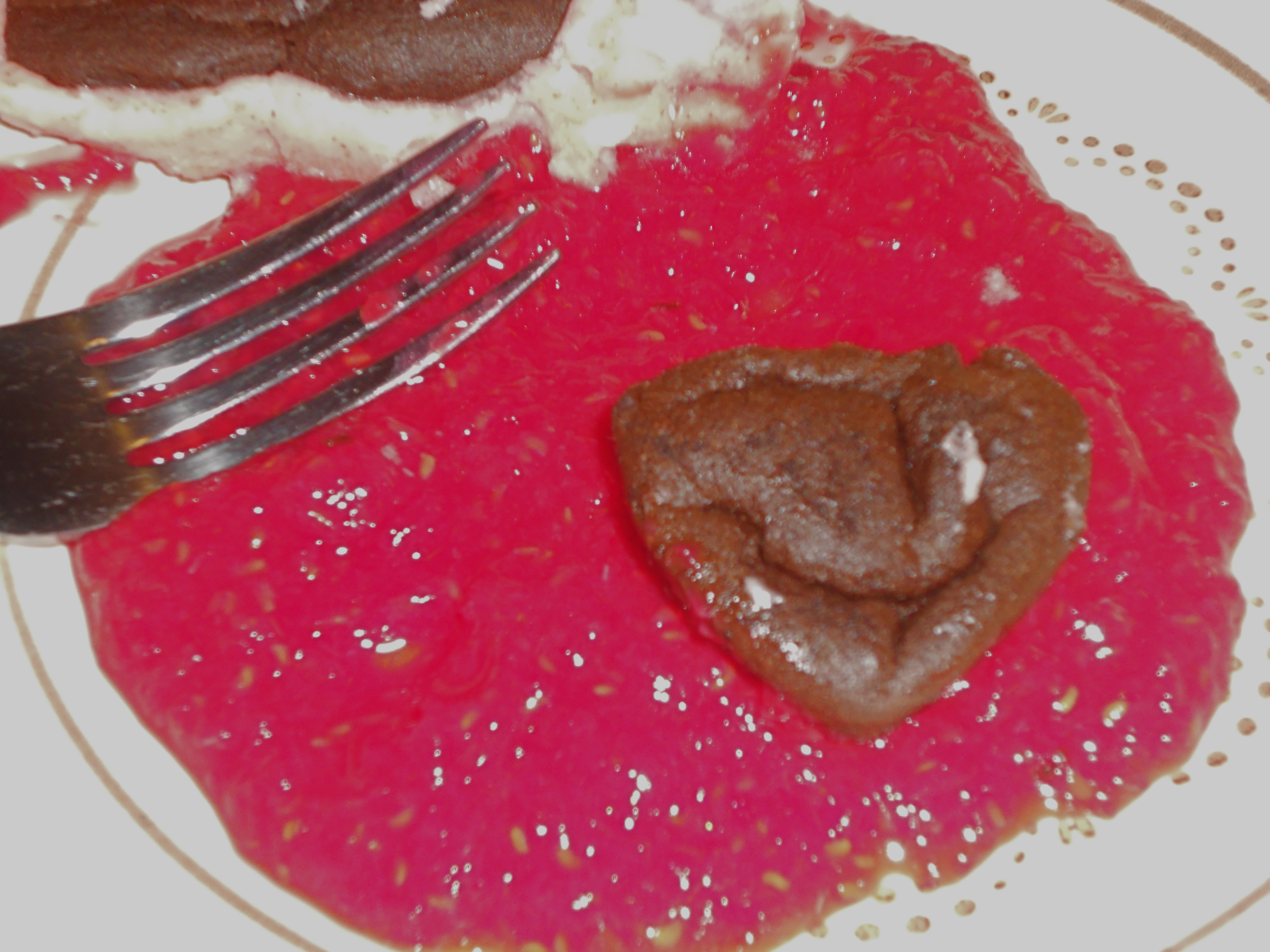
At the store yesterday I grabbed two mixes – one from Gluten-Free Dreams and one I have never tried from King Arthur Flours.   Upon pouring them out of their plastic prisons I immediately noticed that the King Arthur had a smoother texture to it that was less grainy than the GF Dreams.  This would prove itself again when they were mixed and in the final baked products – the King Arthur was fudgey and soft with no trace of gluten-free graininess to it.  The six of us agreed it was the taste-test winner (I’ve tried a few other brands, and this is my favorite out of them all).

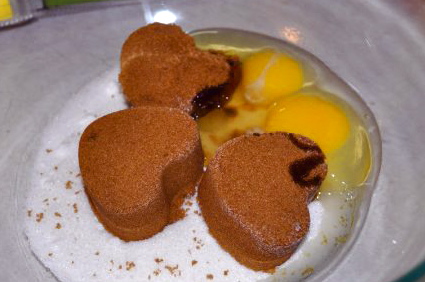
I used canned pumpkin and unsweetened vanilla almond milk as the moisture for the cakes rather than oil and eggs, making them lower in fat and vegan, while tasting just as rich and chocolatey.  Because they’re seemed to not be a matching set of cake pans in the house, I used an 8″ and a 9″, as well as a miniature heart mold that I knew was crammed in a cabinet here somewhere (I’m stealing it).

Now these cakes are so delicious that they don’t need frosting.  I simply pureed three containers of raspberries to make a sauce and it was the perfect accompaniment to the dark and fudgey cake.  But to glue them together and add some color I made a basic buttercream frosting with butter (bye-bye vegan and dairy-free) and a bit of almond milk.  This is only needed if you make two layers.

Speaking of layers – my Portuguese/Italian heritage of always making too much food reared its dark-haired head again, in my making a double layer cake for 7 people!  We had two-thirds of the cake left over.  So if you’re feeding 8-10 people of a healthy appetite, one layer is sufficient for a dense and classy cake.

To simplify, I’m going to give you the recipe just for the King Arthur mix.  If you were to choose the Gluten-Free Dreams, you’d simply reduce the milk by 1/4 of a cup.

Ingredients

  • 2 boxes of King Arthur Flour Gluten-free Chocolate Cake mix
  • 2 cups of pumpkin puree
  • 3 1/2 cups unsweetened milk – I used vanilla almond, but soy or cow would work just as well
  • 5 teaspoons vanilla extract
  • 1 tsp baking soda
  • 3 cups fresh raspberries
  • 2 1/2 cups confectioner’s sugar
  • 1 stick (8 Tbsp) butter, softened
  • red food coloring, if desired

Directions: Cake

  • Preheat oven to 350 degrees.
  • Lightly grease cake pans of choice – I used one 9″ and one 8″ cake pan, plus the little heart molds
  • In a very large bowl: two packages of cake mix, 1 tsp baking powder, 4 tsp vanilla extract, 2 cups of pumpkin puree.
  • With a hand mixer, start to mix on low.  These mixes will easily fly into the air, so consider yourself warned!
  • When the pumpkin is incorporated, make a well in the center of the batter and pour in 2 and 1/2 cups milk (the rest is for the frosting).  Start mixing on low until incorporated, then mix in medium until nice and smooth.
  • Pour into cake pans and bake for approximately 25 minutes, testing after 20, and bake until a toothpick in the center comes out clean.
  • Leave in pans for 15 minutes before inverting onto cooling racks.  Cool completely before frosting.

Directions: Frosting and puree

  • In a food processor, process raspberries until smooth.  Set aside.
  • Clean and remount processor.
  • Whip butter into confectioner’s sugar until incorporated.
  • Add 1 tsp vanilla extract.
  • Slowly pour in almond milk, stopping when frosting is smooth and spreadable.
  • If desired, add about 5 drops of red food coloring until a delightful pink.
  • Put a dab of frosting between the layers, and a bit more on top to decorate as desired.  Serve with raspberry puree.

The Final Product

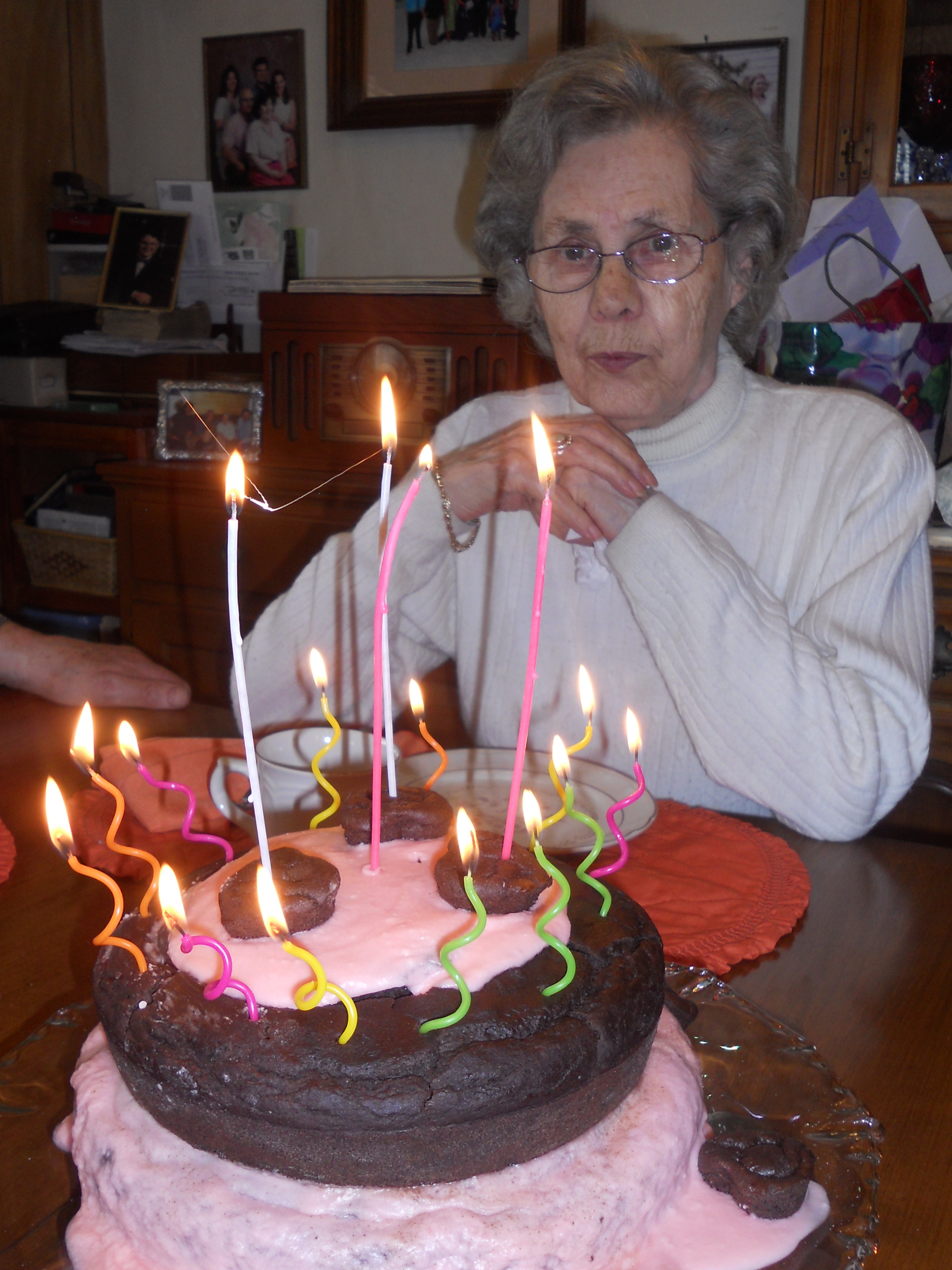
Happy Birthday Nana!

My sister and I dubbed this the Whoville Birthday Valentine Whobilation Cake.  Yes, it looks like something a Who would serve to their guests in a Dr. Seuss world. I do not deny this.  Nor am I too proud to share this with you.  But I did come home and sign up for a cupcake class next month so I can learn how to frost better.  And I think cake classes may be in my future in general.

Sweet Alternatives for a Healthy Valentine

I have a super-sweet tooth, which definitely comes into conflict with my (mostly) sugar-free diet and serious hypoglycemia. So this week I’m highlighting my tricks on foods that satisfy the urge but will leave you feeling energized and full at the same time, without rocking the diet or endangering your health… just in time for Valentine’s Day!

Tip before launching into the list: food combining. I’ll go into details another time, but starches don’t mix well with fruits, causing digestive upset and weight gain (they also don’t mix well with meat… but more on that later). So in satisfying the cravings for sweets, keep this in mind for optimal digestion and weight maintenance. I know I used to love fruit on cereals, or with toast or on cakes, but it’s just so much more worth it to abstain.

From Slimming to Sinful… My Sweet List

  1. ALMOND BUTTER: My favorite sweet-craving alternative is Almond Butter on millet toast or slathered on an apple. Nuts combine well with healthy starches, together making a perfect protein, while giving a boost of protein and filling the belly comfortably. They’re high in monounsaturated fats, so they attack heart disease while being lower in calories than most nuts and super-concentrated with vitamin E. For women, almonds have been known to calm menstrual cramps when consumed daily. And for pregnant women, eating raw almonds is killer when battling nausea.
  2. KOREAN YAM: If you’re an urban-dweller, chances are you’ve seen Korean Yams in your local bodega and had no idea what they were. Also called Chinese Yam and Japanese Mountain Yams, they’re my FAVORITE root vegetable, much like a sweet potato but with a white flesh and a bit drier, sorta resembling boiled chestnuts in taste. From my research I’ve learned they’re great at aiding digestion and fighting fatigue due to the amount of mucin in them, which also aids in relieving constipation and reducing cholesterol! Amazing how the body craves what it needs. My favorite way to eat them is just to wash, poke some holes in and bake them. Or slice and season with a little oil, salt and pepper, and bake until crispy.
  3. SWEET POTATO: One of my little indulgences is Sweet Potato Chips from Terra Chips. Sweet potatoes, canola, sunflower/safflower oil… I’m in heaven. They really satisfy both the sweet and savory cravings. Just be careful – one serving goes down really quickly! To do even better for your body and bake fresh sweet potatoes, try slicing them in chunks or fry shape, and bake with a little oil, salt, pepper, rosemary, cumin, cinnamon… whatever spice combination you want to try… until they’re dark and crispy. A 400 degree oven or hotter usually seals the deal. My mouth is watering…
  4. Cinnamon: So simple, but adding cinnamon to foods tricks the mind, as cinnamon is associated with sweetness. So literally throw it on things you wouldn’t normally think to pair it with: roasted chicken, sauteed greens, on all fruits and plenty of vegetables. It’s great for you, so enjoy!
  5. Beets: Yes, beets are sweet, and great for the liver. To cook to sweetest potential, peel, slice and roast with a little cinnamon and salt still blackened at the edges. Or grab Terra’s Sweets and Beets mix for a ridiculous snack satisfier.
  6. Raw Cacao Nibs: A live super-food, I’ve very recently started adding raw cacao into my diet, and am SO HAPPY to have tried it out. The health benefits are too abundant to repeat here, so just click to be directed to LiveSuperFoods.com, a phenomenal website on all good-things live, with very reasonable prices – I have a feeling I’ll be ordering with them soon. To sum-up: raw cacao has more antioxidants than red wine, blueberries, and 4-times as much as a cup of green tea! Without the additions of processing and sugar, it’s not an indulgence – it’s medicine! The taste is nutty and a bit sharp, and the smell is INCREDIBLE! My boyfriend thought I was baking while sitting next to him, about 2 teaspoons of nibs mixed in my cereal! My favorite way to eat them is on my Uncle Sam’s cereal, or mixed with nuts and goji berries. Speaking of which…
  7. Gogi Berries: Another live super-food that’s been on my list for a while, goji berries are tiny, red and sweet, packing lots of anti-oxidants and strengthening the immune system. You can even get goji-berry juice for a power shot or an addition to smoothies. I add them to apple sauce and power-protein mixes for some sweet satisfaction!
  8. Organic Nectars Raw Agave Gelato: I’m currently exploring agave syrup from Organic Nectars out of Woodstock, NY, a town I’ve never been to but mentally have been stalking for their great products and housing of Phillip Petit.  It’s made from cashews and agave. Way decadent.  And because the agave is raw, it’s not heated and reduced to a syrup that’s worse for you than corn syrup (ew).
  9. COCONUT MILK: Coconut milk is great for you, especially if you have chronic conditions. Blend it with fruit for a smoothie, throw it in an ice-cream maker with crushed fruit for sorbet… have fun!

And now my recipes for guilt-free yummy desserts!

  1. Superfood Ooey-gooey winter warmth: This combines sweet bananas with protein packed nuts for a warming and indulgent treat. Note: this is practically the only time I ever use a microwave… in general, I truly believe stove-top warming is the way to go to avoid unnecessary rays. And careful if consuming too late at night, as the sugar in the banana and the spunk in the cacao can keep you up thinking. Slice an entire banana and microwave in a small bowl for 50 seconds, so that the bottom of the bowl has really soft banana but the top layer is pretty intact, warmed through. To the bowl add any combination of the following: 1 teaspoon almond butter, 10 or so almonds or walnuts, a sprinkle of goji berries, a tablespoon of raw cacao nibs, a generous dose of cinnamon, some natural applesauce… be creative!
  2. Coconut Custard: I’m just gonna skip the blah-blah introduction and go right into a recipe I got from Lissa De Angelis of NEW LIFE – NY YOGA magazine for a decadent coconut custard, so easy to make! 1) Preheat oven to 350 degrees. 2) Puree 2 organic eggs, 2 cups unsweetened coconut milk, 1/4 cup maple syrup, raw honer OR agave syrup, 2 squirts vanilla cream or plan stevia, a few grains of sea salt. 3) Pour into 6 individual ramekins or an oven-proof container. Sprinkle with 1/4 cup shredded coconut (optional) 4) Place ramekins or container into a bath of water and place in oven. 5) Bake until the custard has set, about 30-45 minutes. 6) Cool slightly and serve warm or at room temperature.
  3. Hot Apple Cider: For cold New England winters, nothing beats a hot apple cider with a cinnamon stick. Yes, that’s it… no more too it… just wanna remind you it’s out there for you…
  4. Baked Apples: Again, an oldie but goodie you may have forgotten about – one of the sweetest desserts is the simplest! Take a (preferably) local, organic apple, core it and fill with cinnamon and some sultanas (golden raisins) if you’re not too sugar-sensitive, wrap in foil and bake at 350 until super-soft. To make it a little more filling and add some protein, add some chopped nuts or a drizzle of nut-butter. I find myself often hungrier after I eat an apple, so adding the protein really helps keep me full.

Buck Up with Buckwheat!

It’s cold in New York City.  I sit at the computer, writing away at articles for my job, gobbling hot tea constantly.  And as I puttered around the kitchen this morning, I realized my normal breakfast of eggs and veggies wasn’t gonna cut it. I need something warm, filling and slightly sweet.

Enter BUCKWHEAT.

buckwheat kernals

This gluten-free grain is often overlooked when compared with its massively produced cousin, Oatmeal, but it’s now readily available in health food stores large and small.  It’s not actually a grain, but a seed somewhat related to rhubarb.  It cooks very similarly to oatmeal, though, is as deliciously versatile and is wonderfully filling on mornings when there’s a lot of day to face.  It’s completely gluten-free and a very healthy-happy food.

Healthy-Happy Buckwheat!

  • Completely gluten-free as it’s a seed, so it’s digestible for those with celiac and gluten sensitivities
  • Contains a very high level of magnesium, which relaxes blood vessels and therefore contributes to healthy blood flow and is good for the heart
  • Lowers LDL cholesterol and raises HDL cholesterol (that’s a good thing…)
  • Helps lower and regulate blood-sugar levels by containing chiro-inositol.  Researchers are not sure why this does what it does quite yet, but in humans and animals alike, whole grains containing this compound lowered blood-sugar levels by 12-19% when compared with those given a placebo (check it out at WHFoods)
  • Generally high in antioxidants, so is generally an on-your-side superfood

Let’s Cook It!

Some cook buckwheat as an alternative to rice.  I prefer it as a porridge, all gooey and slightly sweet.  Below is my recipe for a coconut-buckwheat cereal.  Alternatives would be to cook with water or an animal milk, then add any variety of vanilla extract, cinnamon, dried or fresh fruits, carob powder, fresh nutmeg, chai… the list goes on.  I prefer coconut milk on some mornings because it makes the porridge thicker and naturally sweet and creamy.  I pressure cook my morning grains normally, as it adds to the digestion ease and also makes the grains that much more moist and fluffy.  Toasting them for a few minutes on dry heat before adding the liquid increases their digestibility.  Directions for pressure-cooking and stove top cooking are below.

Ingredients

  • 1 cup of buckwheat
  • 2 cups of liquid – I used a can of light coconut milk and then topped off the rest with water
  • 1 tsp maple syrup (per serving)
  • dried cranberries, golden raisins or blueberries (preferably sugar and nitrate-free)
  • raw or toasted nuts (I used pecans, but hazelnuts or almonds would also be delightful)

Directions:

  1. Pressure Cook Grains: Add grains and liquid into a pressure cooker, bring up to full heat (you’ll know because it’ll be sizzling away, making lots of noise and releasing some steam), cook for 12 minutes, then turn off the heat and let pressure release naturally.
  2. Stove-top Cooking Grains:  Toast the grains in a dry pot on medium heat, stirring continually, until they become nutty and fragrant.  Add the liquid, bring to a boil, then cover and reduce heat to a simmer.   Cook about 15-20 minutes until all the liquid is absorbed.
  3. Serve with 1 tsp of maple syrup per serving, and a small handful of raw nuts and dried fruit.

Note: Adding a non-animal protein such as nut-butter or eggs is a great way to make this breakfast a perfect protein and aid digestion.  I actually rarely do such heavy grains first thing in the morning as I can’t digest nuts well in the early day, but as a sweet-treat and with some extra digestive boosting supplements, it’s a great way to face the rain.

How to make this a dessert? Simmer about 2 1/2 cups coconut milk on the stove, adding 4 tablespoons maple syrup, 2+ teaspoons each of vanilla extract and cinnamon and, if you want to live dangerously, a little dark rum.  Add grains and cook on low until thick and sweet.  Whip a whole egg and add in just before the grains are fully cooked, stirring thoroughly.  Taste and add seasonings to your preference.  Remove to a wide pan and refrigerate until cold.  Sprinkle with cinnamon, raisins and (if desired) a little more agave.

Bourbon Molasses Apple Pie (with candied bacon)

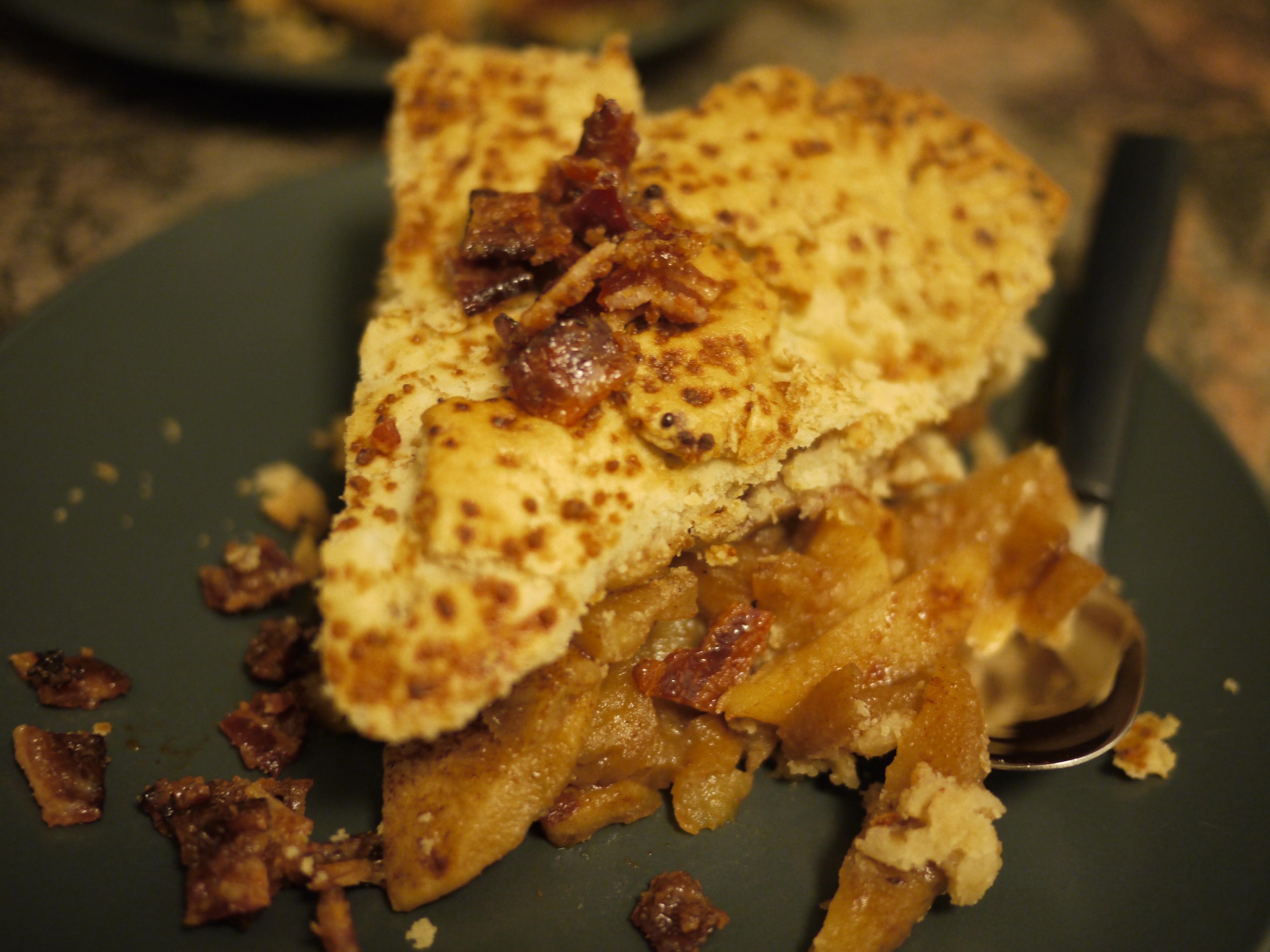
Bourbon Molasses Apple Pie with candied bacon

The problem with living in the best city in the world is that you can plan a refined night for you and your significant other of theatre and a late supper at a French restaurant, and then end up going to the theatre, then a rock club, then a blues club, then an Eastern European dive bar until the wee hours of morning, all the while proclaiming “we live in the best city in the world!”

Naturally, sleeping in the following morning was required.  And then the long subway ride home had me maneuvering construction-ed lines, packed by panicked tourists who ripped the bag of groceries I had been schlepping for far too many transfers.

But at least I was going home to PIE.  Apple pie, with molasses and bourbon and a bit of candied bacon on top.  As I was groggily hitting the elevator button, the boyfriend remarked that I had yet to bake him a pie.  As fellow dusty bakers can understand, this was less of a histrionically domestic complaint and more a phrase of endearment that had me humming on my way to the grocery.   My day had taken a turn to the apple world.  It’s a sweet world.

This is the third version of this recipe, lovingly entitled “Punch Yo Mama Kentucky Apple Pie”.  From my time on the border of Kentucky, I learned that those people do well with delicious food and honor their bourbon.

In the last two test versions the molasses flavor held its own but there was virtually no bourbon flavor.  So instead of heating the bourbon and molasses to make a glaze (which I found killed the taste of the alcohol) I blended them at room temperature with a little tapioca starch to thicken the mixture.  I also included bourbon into the pie crust, finding that the flavor works well baked in flours.  Previously I candied thick-cut bacon with a molasses / brown sugar mixture and baked it into the pie – this time candied thinner bacon and sprinkled it on when serving to retain its crunch.

The result?  The bourbon flavor came though just enough that you’d notice but not be overwhelmed by it.  I had added no sugar to the apples, and they came out sweet and caramely, and the cinnamon gave them a bit of punch.  The crust was a bit too crumbly on day one, but definitely didn’t distract, and was soft and manageable on day two.  (For a flawless crust try my Perfect Gluten-Free Pie Crust) By far the apple/molasses/bourbon combination was killer!  And the bacon was so crunchy and sweet that the crusts don’t even need sugar.

Notes: You can use regular white flour in the crust, or experiment with gluten-free flour blends you like using. This crust was a bit crumbly – I’d stick to my easy gluten-free crust or Perfect Gluten-Free Pie Crust, including the bourbon instead of water as suggested below.  If going gluten-free, just make sure you have enough starch and xantham gum to pull the flour together.  You can also use butter-flavored Earth Balance and omit the egg to make this dairy-free and vegan.  I’m experimenting with sugars lately, and used just a tiny bit in this, but it really doesn’t matter what kind of sweetener you use.  Yes, the flavor will vary slightly, but that’s one of the beautiful things about pies: make a crust and fill it with fruit and chances are you’re going to be happy.

Ingredients:

For the filling:

  • 14 small apples, preferably of three varieties
  • 2 Tbsp. bourbon
  • 3 Tbsp. molasses
  • 2 tsp. starch (I used tapioca)
  • 2 tsp. cinnamon (preferably two different, pungent varieties – I used Indonesian and Chinese)
  • Freshly grated nutmeg, about 1/2 tsp.

For the crust:

  • 1 cup white rice flour
  • 1/2 cup amaranth flour
  • 1/2 cup sweet white sorghum flour
  • 1/2 cup tapioca starch
  • 1 1/2 tsp. xantham gum
  • 1/2 tsp. salt
  • 2 Tbsp. sweetener – I used sucanat, crushed cane sugar, because I accidentally picked it up instead of fructose, which I was going to try using.  I’m still working on which sweetener I like best for health / baking reasons.
  • 16 Tbsp. butter, cut into cubes
  • 2 Tbsp. bourbon
  • 4 Tbsp. ice cold water
  • 1 egg, beaten, for brushing on the top of the pie.  You can also use egg white, melted butter or water.

For the Bacon:

  • 5 slices of thin bacon
  • Your choice of sugar – brown sugar or sucanat will flavor best

Directions:

Prepare the Filling:

  1. Preheat the oven to 375 degrees F.
  2. Peel, core and slice apples, and let them sit in a strainer.
  3. In a small bowl, mix molasses, bourbon and starch.  Blend with a fork.
  4. Separate the apples onto two cookie sheets with high rims.  Pour 1/2 of the molasses mixture on each sheet, and mix thoroughly with your hands until the apples are coated.
  5. Sprinkle with each tray with 1/2 of the cinnamon and nutmeg
  6. Bake in the oven for about 15 minutes or until just soft while you prep the crust.

For the crust: I use a standing mixer with the paddle attachment.

  1. Place flours, starch, xantham gum, salt and sugar in the bowl and whisk together.
  2. Toss in butter and start to mix on low speed until the butter is cut in, about 3-5 minutes.
  3. Add the bourbon one tablespoon at a time, and then the water, using only just enough for the dough to pull together.
  4. On a floured pastry board, roll half of the pastry into a disk to fit your pie plate.  I make sure to thoroughly turn and flip my dough so that it doesn’t stick, as gluten free dough can break easily.
  5. Fill the plate with apples, tapping down slightly.
  6. Roll out the top crust, close pie, seal the edges with a fork.
  7. Mix a teaspoon of water with a slightly beaten egg, brush the top of the pie, and sprinkle with sugar if desired (After sampling, the pie was sweet enough without the sugar and would have been prettier if I had omitted it).
  8. Bake for 45 minutes, covering the edges of the pie halfway through to prevent browning, or until top of pie is slightly browned and apples cooked through.

To candy the Bacon:

  1. Heat the oven to 400 degrees F.
  2. Fit roasting rack into a cookie sheet and spray with non-stick cooking spray.
  3. Place sugar of choice in a small bowl, and thoroughly coat bacon with sugar.
  4. Place on cooking rack and sprinkle more sugar on top of each slice.
  5. Cook for five minutes and, if desired, turn bacon and sprinkle with more sugar.
  6. Cook for five more minutes, remove from oven and remove bacon to a plate to cool completely before chopping into small bits.
  7. Sprinkle on top slices of pie for serving.

Coconut Milk Rice Pudding

It’s freezing in New York City.  By the time this is posted, the snow will be falling once again and NYC will have gotten more snow in January than any January in history.

Which is why this weekend I’ll be grabbing the ingredients for this warm and filling dessert that I made up last year while similarly freezing in Cincinnati.  It’s not too sweet, and a delicious dairy-free alternative to that gorgeous pudding that too often stares at me from behind the windows at Italian and Portuguese restaurants, eying me up and down as I sip my espresso.

Health notes: This recipe contains coconut milk (with medium-chained fatty acids, it’s very anti-carcinogenic, anti-microbial, anti-bacterial and anti-viral, and helps build strong bones), and cinnamon (which helps to regulate blood sugar, has been shown to help arthritis symptoms and has a whole load of other health properties).

Ingredients:

  • 1/2 cup long grain or basmati rice
  • 1 cup coconut milk with 1 1/2 cups water
  • 1 1/2 additional cups coconut milk
  • golden raisins / sultanas (about 1/2 cup but to taste)
  • 1 cinnamon stick
  • ground cinnamon to taste
  • fresh nutmeg
  • 1 tsp lemon rind
  • 2 teaspoons vanilla extract
  • your favorite sweetener to taste

Directions:

  • Cook the rice in your favorite form (stove top, pressure cooker, rice cooker etc.) with the 1 cup coconut milk, 1 1/2 cups water and raisins until all liquids are absorbed, the rice is soft and the raisins are plumped.
  • Add the extra 1 1/2 cups coconut milk, cinnamon stick, lemon rind, and vanilla and bring to a simmer, stirring occasionally.
  • When the liquid has reduced by half, add about 2 tablespoons of sweetener, 1 teaspoon of ground cinnamon and about 1/2 teaspoon nutmeg and taste.  Add more sweetener as desired.
  • Simmer until the liquid is absorbed to almost an oatmeal-like consistency.  Any further and it will dry out before being served.
  • Serve warm or chilled, with additional cinnamon on top or with sprinkled raisins or coconut.

Lavender Tea Cookies

I’m playing around with different gluten-free mixes and wanted to check out another from 1-2-3 Gluten Free (I reviewed their Pan Bar Mix).  So I’m testing their “Roll-out & Cut Sugar Cookies”, which are free of gluten, wheat, dairy, caseins, peanuts, tree-nuts, corn, egg and soy!  The mix does contain sugar, so be careful if you’re diabetic, hypoglycemic, or generally avoid white sugar.  Other than that, it’s a basic mix of rice flour, tapioca flour, potato starch and the necessary xantham gum and baking powder.

To make it extra special for my gluten-dairy-free-British colleague Dale I added adding some delicate dried lavender to make a tea-tasty cookie.

I had attempted to bake the cookies two different ways – first by rolling and cutting out as the mix suggests, then by rolling the dough with my hands into a ball and pressing flat, crisscrossing with a fork (with the intention to see if this may make a suitable snickerdoodle dough).  But my dough was too dry to roll out, and crumbled on my pastry board.  So I rolled about 1 tablespoon of dough with my hands and flattened it a tiny bit, placing 12 cookies about 2 inches apart on a thin baking sheet.

The result: Well, these cookies are very sweet to me.  But I like my pastries just-sweet, so this is probably good news for other bakers out there.  They do taste remarkably close to regular sugar cookies, even despite the lack of butter.  Mine are much thicker than what this recipe is intended for (rolling them thin and cutting them can make 40-100 cookies, my batch yielded 36), but the texture is great – soft and slightly crumbly.  The essence of lavender is perfect (I’d say 1/4 cup or less…).  Overall, I’m a little disappointed I couldn’t roll them out, but think it’s a great standard cookie mix.  And they’d make a great snickerdoodle by adding 2 teaspoons of cinnamon to the mix and rolling in cinnamon before baking.

Ingredients:

  • 1 box 1-2-3 Gluten Free Sugar Cookie Mix
  • 1 cup vegetable shortening
  • 1 egg and 1 egg yolk, at room temperature
  • 1/4 – 1/3 cup dried edible lavender (you can get this at most bulk food / tea stores.  Any lavender you’d use for tea is appropriate for baking)

Directions:

  1. In a standing mixer with the paddle attachment, cream shortening until smooth, about 3 minutes
  2. Add 1/2 cup of the flour mixture and blend thoroughly.
  3. Add egg and egg yolk, and beat until incorporated
  4. Add the rest of the flour mixture and beat until incorporated, scraping down the sides of the bowl, until you can make a solid dough-ball.
  5. Add the lavender and mix quickly until evenly dispersed (I tasted a bit of my mix to make sure I had the light flavor and scent I desired)
  6. Divide dough into two balls, wrap in plastic wrap and refrigerate for at least 1 hour until firm
  7. When dough is ready, preheat oven to 375 degrees F
  8. Using 1 tablespoon portions, roll dough into a ball and flatten slightly.  Place on baking tray 2 inches apart and bake for about 13 minutes (I discovered that putting them in the middle of the oven made the bottoms brown but not the tops, so I moved the second round to the top third of the oven)
  9. Let cool slightly and transfer to wire rack